In 2026, artificial intelligence has evolved from an experimental competitive advantage into core enterprise operational infrastructure. Enterprise leadership no longer asks if AI should be adopted, but rather how to deploy artificial intelligence models into mission-critical production environments reliably, securely, and within predictable financial parameters.
Despite massive capital investments, over 78% of corporate AI initiatives remain trapped in Proof-of-Concept (PoC) stagnation. Enterprise IT infrastructure was engineered for deterministic, rule-based software systems. Integrating non-deterministic, probabilistic artificial intelligence—such as Large Language Models (LLMs), Small Language Models (SLMs), and multi-agent autonomous workflows—into legacy ERP suites, CRM platforms, and custom SQL databases introduces unprecedented technical friction.
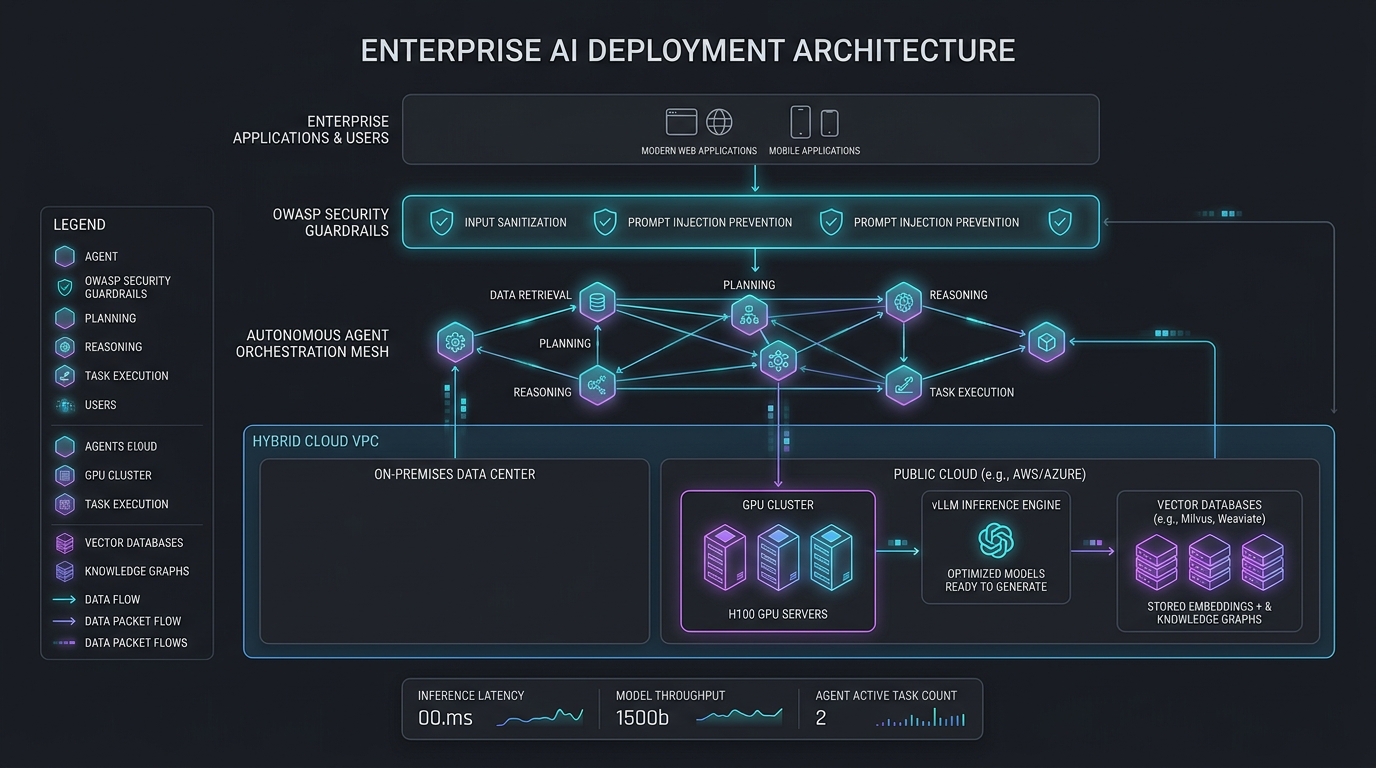
// Visual Architectural Blueprint: Enterprise Hybrid AI Deployment Topology with OWASP Security Gates, vLLM Serving, and Autonomous Agent Orchestration
1. Core Concepts & Fundamentals of AI Deployment
To architect a scalable deployment strategy, technology leaders must first understand the fundamental building blocks of modern enterprise AI infrastructure:
1.1 Model Serving & Inference Optimization
Deploying an AI model requires converting raw parameters into a high-throughput, low-latency API endpoint. Standard Python wrappers fail under enterprise concurrency. Production environments rely on specialized inference engines:
- vLLM: Utilizes PagedAttention to eliminate memory fragmentation in Key-Value (KV) caching, enabling up to 24x higher throughput compared to native Hugging Face Transformers.
- NVIDIA TensorRT-LLM: Delivers hardware-accelerated inference compiling custom kernels specifically for NVIDIA H100, H200, and B200 GPUs.
- Quantization Frameworks: Techniques like FP8 (8-bit floating point) and INT4 AWQ (Activation-aware Weight Quantization) reduce memory footprint by 50%–75% with negligible accuracy degradation, allowing 70B parameter models to run on single enterprise GPU nodes.
1.2 Knowledge Augmentation: RAG vs. GraphRAG vs. Fine-Tuning
A common failure pattern is assuming fine-tuning is required for knowledge retrieval. Enterprise deployment categorizes these methodologies strictly by operational use case:
| Methodology | Best Used For | Data Recency | Governance |
|---|---|---|---|
| RAG | Unstructured search, document Q&A | Real-time | ACL Enforced |
| GraphRAG | Multi-hop reasoning, relational entity mapping | Near real-time | Node-level RBAC |
| Fine-Tuning | Domain syntax, style, specialized terminology | Static snapshot | Static Weights |
1.3 Agentic Workflows & Tool-Calling Integration
Modern deployment extends beyond text generation to autonomous execution. Autonomous agents utilize open protocols like the Model Context Protocol (MCP) to inspect database schemas, call REST APIs, execute code in sandboxed containers, and trigger human approval workflows when operational thresholds are breached.
2. Enterprise AI Deployment Architecture
Selecting the right deployment topology depends on data classification, regulatory requirements, latency SLAs, and total cost of ownership.
- Cloud SaaS Deployment (Frontier Model APIs): Direct integration with multi-tenant SaaS APIs (e.g., OpenAI, Anthropic). Ideal for instant access to frontier reasoning, but carries data egress and compliance risks under frameworks like the India DPDP Act or EU AI Act.
- Private Cloud VPC & Sovereign On-Premise Deployment: Deploying open-weights models (e.g., Llama 3.3 70B, Qwen 2.5, DeepSeek R1) inside an isolated Virtual Private Cloud (AWS VPC, Azure Private Link, GCP). Ensures 100% data sovereignty and predictable fixed hosting costs. Learn more about deploying private local LLMs.
- Edge Deployment: Quantized Small Language Models (1B–8B parameters) running on edge hardware or factory-floor gateways for sub-10ms latency and 100% offline operational capability.
3. Enterprise Use Cases & Industry Applications
BFSI & Financial Services
Real-time fraud detection and automated underwriting pipelines linking core banking databases (Oracle/DB2) to underwriting policy manuals under PCI-DSS and SOC 2 Type II compliance.
Manufacturing & Supply Chain
Edge SLMs process IoT telematics on factory gateways. Anomaly spikes automatically trigger maintenance tickets in ERP suites (SAP S/4HANA), reducing downtime by up to 40%.
Healthcare & Pharma
Private local LLMs format clinical notes and map complex medical trial protocols while maintaining zero HIPAA data leakage.
Software Delivery (AI SDLC)
Autonomous code-review agents integrated into CI/CD pipelines evaluate PR quality, verify security, and write self-healing QA test suites. See our autonomous PR review SDLC agent pipeline.
4. Step-by-Step Enterprise AI Deployment Framework
Transitioning from strategy to scaled production requires a disciplined 4-phase rollout plan:
- Phase 1: Strategy & Sprint Zero (Weeks 1–2): Conduct a data readiness and security classification audit. Execute a 5-day Sprint Zero to build a prototype and define SLA latency constraints. Reference our AI implementation roadmap for mid-market companies.
- Phase 2: Architecture & Guardrail Setup (Weeks 3–5): Provision isolated VPC container infrastructure (Kubernetes GPU pools), deploy vLLM serving, and activate input/output prompt sanitization guardrails.
- Phase 3: Legacy System Integration & Multi-Agent Mesh (Weeks 6–9): Wire agent tool-calling capabilities to enterprise REST APIs and SQL databases with granular Relationship-Based Access Control (ReBAC). Read more on enterprise custom AI integration for legacy systems.
- Phase 4: Production Rollout, FinOps & Evals (Weeks 10+): Execute canary rollouts (5% → 25% → 100%), run automated evaluation suites, and transition to long-term SLA monitoring through a Care & Scale retainer.
5. Real-World Implementation Examples & ROI Mathematics
Executive sponsorship requires demonstrating indisputable financial viability. The 24-month Total Cost of Ownership (TCO) equation compares SaaS APIs against private self-hosted SLMs:
Consider an enterprise support operation processing 50 million tokens per day:
- SaaS API (GPT-4o): ~$6,000 / month ($144,000 over 24 months).
- Private Self-Hosted SLM (Llama 3.3 70B on Dedicated 2x L40S GPU Node): ~$2,225 / month including hosting and amortized setup ($53,400 over 24 months).
- Net 24-Month Savings: $90,600 (62.9% Cost Reduction with 100% Data Sovereignty).
For deep quantitative models, read the engineering math behind zero-cost local AI and how to calculate the ROI of custom AI development.
6. Security Risks & OWASP Top 10 for LLMs
Enterprise AI deployment requires active protection against unique vulnerability vectors outlined in the OWASP LLM security framework:
- LLM01: Prompt Injection: Prevented by separating untrusted user input from system instructions using explicit delimiters and deterministic input sanitization microservices.
- LLM02: Sensitive Information Disclosure: Mitigated via automated outbound Regex and NER redact filters that screen PII, API tokens, and secret keys before model output reaches the client.
- LLM06: Excessive Agency: Enforced through strict non-human identity limits. Autonomous agents are never granted global DB root access; every action executes within scoped, time-bound OAuth tokens subject to ReBAC policies.
Explore our technical guide on autonomous AI agents for business for expanded OWASP security audit protocols.
7. Best Practices & Common Enterprise Mistakes
| Enterprise Best Practices | Common Deployment Mistakes |
|---|---|
| Decouple model architecture using Model Context Protocol (MCP) wrappers. | The "Everything SaaS" trap sending PII across unmonitored endpoints. |
| Deploy semantic caching (Redis) for 0ms latency on repeated queries. | Granting agents global root DB access without granular ReBAC IAM. |
| Implement continuous regression eval test suites on every commit. | Over-engineering static fine-tuning instead of dynamic GraphRAG. |
| Partner with teams delivering in fixed-price weekly sprints. | Entering open-ended hourly agency billing contracts. |
8. Enterprise Production Readiness Checklist
Conclusion: Partner with Deployed Minds
Deploying enterprise AI is a software engineering discipline. At Deployed Minds, we build custom AI software, deploy private local LLMs, engineer autonomous agentic workflows, and integrate AI microservices into legacy corporate systems. Operating through fixed-price weekly sprints, our senior engineering teams deliver production-ready software every Friday.